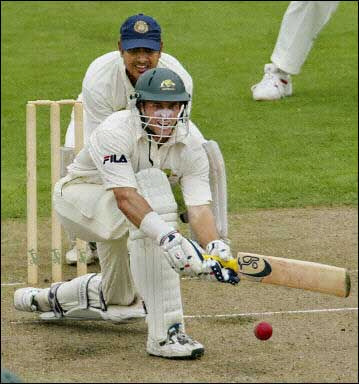
Cricket is a bat-and-ball team sport. Many variations exist, with its most popular form played on an oval-shaped outdoor arena known as a cricket field at the centre of which is a rectangular 22-yard (20.12 m) long pitch that is the focus of the game. A game (or match) is contested between two teams of eleven players each. One team bats, trying to score as many runs as possible while the other team bowls and fields, trying to dismiss the batsmen and thus limit the runs scored by the batting team. A run is scored by the striking batsman hitting the ball with his bat, running to the opposite end of the pitch and touching the crease there without being dismissed. The teams switch between batting and fielding at the end of an innings.

There are also variations in the length of a game of cricket. In professional cricket this ranges from a limit of 20 overs per side (Twenty20) to a game played over 5 days (Test cricket, which is the highest level of the game). Depending on the form of the match being played, there are different rules that govern how a game is won, lost, drawn or tied. The rules of two-innings games are known as the Laws of Cricket and maintained by the International Cricket Council (ICC) and the Marylebone Cricket Club (MCC); additional Standard Playing Conditions for Test matches and One Day Internationals augment these laws.[1] In one version of Indoor Cricket, matches include just 6 players per side and include two 12-over innings.[2]
Cricket was first documented as being played in southern England in the 16th century. By the end of the 18th century, it had developed to the point where it had become the national sport of England. The expansion of the British Empire led to cricket being played overseas and by the mid-19th century the first international matches were being held. The ICC is the game's governing body and currently has 105 member countries.[3] Cricket is most popular in the Test playing countries.
History
Main article: History of cricket
The Royal Grammar School, Guildford, was the site for cricket's earliest definite reference

Early cricket was at some time or another described as "a club striking a ball (like) the ancient games of club-ball, stool-ball, trap-ball, stob-ball".[4] Cricket can definitely be traced back to Tudor times in early 16th-century England. Written evidence exists of a game known as creag being played by Prince Edward, the son of Edward I (Longshanks), at Newenden, Kent in 1301[5] and there has been speculation, but no evidence, that this was a form of cricket.
A number of other words have been suggested as sources for the term "cricket". In the earliest definite reference to the sport in 1598,[6] it is called creckett. Given the strong medieval trade connections between south-east England and the County of Flanders when the latter belonged to the Duchy of Burgundy, the name may have been derived from the Middle Dutch[7] krick(-e), meaning a stick (crook); or the Old English cricc or cryce meaning a crutch or staff.[8] In Old French, the word criquet seems to have meant a kind of club or stick.[9] In Samuel Johnson's Dictionary, he derived cricket from "cryce, Saxon, a stick".[10] Another possible source is the Middle Dutch word krickstoel, meaning a long low stool used for kneeling in church and which resembled the long low wicket with two stumps used in early cricket.[11] According to Heiner Gillmeister, a European language expert of Bonn University, "cricket" derives from the Middle Dutch phrase for hockey, met de (krik ket)sen (i.e., "with the stick chase").[12] Dr Gillmeister believes that not only the name but the sport itself is of Flemish origin.[13]
In 1598,[6] a court case referred to a sport called creckett being played by boys at the Royal Grammar School, Guildford around 1550. This is the sport's earliest definite mention. It is believed that it was originally a children's game but references around 1610[14] indicate that adults had started playing it and the earliest reference to inter-parish or village cricket occurs soon afterwards. In 1624, a player called Jasper Vinall was killed when he was struck on the head during a match between two parish teams in Sussex.[15]
The first English touring team on board ship at Liverpool in 1859
During the 17th century, numerous references indicate the growth of cricket in the south-east of England. By the end of the century, it had become an organised activity being played for high stakes and it is believed that the first professionals appeared in the years following the Restoration in 1660. A newspaper report survives of "a great cricket match" with eleven players a side that was played for high stakes in Sussex in 1697 and this is the earliest known reference to a cricket match of such importance.
The game underwent major development in the 18th century and became the national sport of England. Betting played a major part in that development with rich patrons forming their own "select XIs". Cricket was prominent in London as early as 1707 and large crowds flocked to matches on the Artillery Ground in Finsbury. The single wicket form of the sport attracted huge crowds and wagers to match. Bowling evolved around 1760 when bowlers began to pitch the ball instead of rolling or skimming it towards the batsman. This caused a revolution in bat design because, to deal with the bouncing ball, it was necessary to introduce the modern straight bat in place of the old "hockey stick" shape. The Hambledon Club was founded in the 1760s and, for the next 20 years until the formation of MCC and the opening of Lord's Old Ground in 1787, Hambledon was both the game's greatest club and its focal point. MCC quickly became the sport's premier club and the custodian of the Laws of Cricket. New Laws introduced in the latter part of the 18th century included the three stump wicket and leg before wicket (lbw).
Don Bradman had a Test average of 99.94 and an overall first-class average of 95.14, records unmatched by any other player.[16]
The 19th century saw underarm bowling replaced by first roundarm and then overarm bowling. Both developments were controversial. Organisation of the game at county level led to the creation of the county clubs, starting with Sussex CCC in 1839, which ultimately formed the official County Championship in 1890. Meanwhile, the British Empire had been instrumental in spreading the game overseas and by the middle of the 19th century it had become well established in India, North America, the Caribbean, South Africa, Australia and New Zealand. In 1844, the first international cricket match took place between the United States and Canada (although neither has ever been ranked as a Test-playing nation).
In 1859, a team of England players went on the first overseas tour (to North America) and in 1862, an English team made the first tour of Australia. In 1876–77, an England team took part in the first-ever Test match at the Melbourne Cricket Ground against Australia.
W G Grace started his long career in 1865; his career is often said to have revolutionised the sport.[17] The rivalry between England and Australia gave birth to The Ashes in 1882 and this has remained Test cricket's most famous contest[citation needed]. Test cricket began to expand in 1888–89 when South Africa played England. The last two decades before the First World War have been called the "Golden Age of cricket". It is a nostalgic name prompted by the collective sense of loss resulting from the war, but the period did produce some great players and memorable matches, especially as organised competition at county and Test level developed.
The inter-war years were dominated by one player: Australia's Don Bradman, statistically the greatest batsman of all time. It was the determination of the England team to overcome his skill that brought about the infamous Bodyline series in 1932–33, particularly from the accurate short-pitched bowling of Harold Larwood. Test cricket continued to expand during the 20th century with the addition of the West Indies, India, and New Zealand before the Second World War and then Pakistan, Sri Lanka, and Bangladesh in the post-war period. However, South Africa was banned from international cricket from 1970 to 1992 because of its government's apartheid policy.
Cricket entered a new era in 1963 when English counties introduced the limited overs variant. As it was sure to produce a result, limited overs cricket was lucrative and the number of matches increased. The first Limited Overs International was played in 1971. The governing International Cricket Council (ICC) saw its potential and staged the first limited overs Cricket World Cup in 1975. In the 21st century, a new limited overs form, Twenty20, has made an immediate impact.
[edit]Rules and Game-play
A typical cricket field.
Main article: Laws of cricket
A cricket match is played between two teams (or sides) of eleven players each[18][19] on a field of variable size and shape. The ground is grassy and is prepared by groundsmen whose jobs include fertilising, mowing, rolling and levelling the surface. Field diameters of 137–150 metres (150–160 yd) are usual.[20] The perimeter of the field is known as the boundary and this is sometimes painted and sometimes marked by a rope that encircles the outer edge of the field. The Laws of Cricket do not specify the size or shape of the field[21] but it is often oval – one of cricket's famous venues is called The Oval.
The key action takes place in a specially prepared area of the field (generally in the centre) that is called the pitch. A run is scored when the batsman has run the length of the pitch after hitting the ball with his bat, although as explained below there are many ways of scoring runs.[22] If the batsmen are not attempting to score any more runs, the ball is dead and is returned to the bowler to be bowled again.[23]
Before play commences, the two team captains toss a coin to decide which team shall bat or bowl first.[19] The captain who wins the toss makes his decision on the basis of tactical considerations which may include the current and expected field and weather conditions.[24]
The bowling side seeks to dismiss the batsmen by various means[25] until the batting side is all out, whereupon the side that was bowling takes its turn to bat and the side that was batting must take the field.[26]
In professional matches, there are 15 people on the field while a match is in play. Two of these are the umpires who regulate all on-field activity. Two are the batsmen, one of whom is the striker as he is facing the bowling; the other is called the non-striker. The roles of the batsmen are interchangeable as runs are scored and overs are completed. The fielding side has all 11 players on the field together.[19] One of them is the bowler, another is the wicketkeeper and the other nine are called fielders. The wicketkeeper (or keeper) is nearly always a specialist but any of the fielders can be called upon to bowl.
[edit]Objectives
The objective of each team is to score more runs than the other team and to completely dismiss the other team. In limited overs cricket, winning the game is achieved by scoring the most runs, even if the opposition has not been completely dismissed. In Test cricket, it is necessary to score the most runs and dismiss the opposition twice in order to win the match, which would otherwise be drawn.
[edit]Pitch, wickets and creases
Main articles: Cricket pitch, Wicket, and Crease (cricket)
See also: Stump (cricket) and Bail (cricket)
The cricket pitch dimensions
At either end of the pitch, 22 yards (20 m) apart, are placed the wickets. These serve as a target for the bowling (aka fielding) side and are defended by the batting side which seeks to accumulate runs. The pitch is 22 yards (20 m) or one chain[27] in length between the wickets and is 10 feet (3.0 m) wide. It is a flat surface and has very short grass that tends to be worn away as the game progresses. The "condition" of the pitch has a significant bearing on the match and team tactics are always determined with the state of the pitch, both current and anticipated, as a deciding factor.
Each wicket consists of three wooden stumps placed in a straight line and surmounted by two wooden crosspieces called bails; the total height of the wicket including bails is 28.5 inches (720 mm) and the combined width of the three stumps is 9 inches (230 mm).
Aerial view of the MCG displaying the stadium, ground and pitch
Four lines, known as creases, are painted onto the pitch around the wicket areas to define the batsman's "safe territory" and to determine the limit of the bowler's approach. These are called the "popping" (or batting) crease, the bowling crease and two "return" creases.
A wicket consists of three stumps that are hammered into the ground, and topped with two bails.
The stumps are placed in line on the bowling creases and so these must be 22 yards (20 m) apart. A bowling crease is 8 feet 8 inches (2.64 m) long with the middle stump placed dead centre. The popping crease has the same length, is parallel to the bowling crease and is 4 feet (1.2 m) in front of the wicket. The return creases are perpendicular to the other two; they are adjoined to the ends of the popping crease and are drawn through the ends of the bowling crease to a length of at least 8 feet (2.4 m).
When bowling the ball, the bowler's back foot in his "delivery stride" must land within the two return creases while his front foot must land on or behind the popping crease. If the bowler breaks this rule, the umpire calls "No ball".
The importance of the popping crease to the batsman is that it marks the limit of his safe territory for he can be stumped or run out (see Dismissals below) if the wicket is broken while he is "out of his ground".
[edit]Bat and ball
Main articles: Cricket bat and Cricket ball
A cricket bat, front and back.
The essence of the sport is that a bowler delivers the ball from his end of the pitch towards the batsman who, armed with a bat is "on strike" at the other end.
The bat is made of wood (usually White Willow) and has the shape of a blade topped by a cylindrical handle. The blade must not be more than 4.25 inches (108 mm) wide and the total length of the bat not more than 38 inches (970 mm).
The ball is a hard leather-seamed spheroid with a circumference of 9 inches (230 mm). The hardness of the ball, which can be delivered at speeds of more than 90 miles per hour (140 km/h), is a matter for concern and batsmen wear protective clothing including pads (designed to protect the knees and shins), batting gloves for the hands, a helmet for the head and a box inside the trousers (to protect the crotch area). Some batsmen wear additional padding inside their shirts and trousers such as thigh pads, arm pads, rib protectors and shoulder pads.
[edit]Umpires and scorers
Main articles: Umpire (cricket) and Scorer
The game on the field is regulated by two umpires, one of whom stands behind the wicket at the bowler's end, the other in a position called "square leg", a position 15–20 metres to the side of the "on strike" batsman. When the bowler delivers the ball, the umpire at the wicket is between the bowler and the non-striker. The umpires confer if there is doubt about playing conditions and can postpone the match by taking the players off the field if necessary, for example rain or deterioration of the light.
An umpire
Off the field and in televised matches, there is often a third umpire who can make decisions on certain incidents with the aid of video evidence. The third umpire is mandatory under the playing conditions for Test matches and limited overs internationals played between two ICC full members. These matches also have a match referee whose job is to ensure that play is within the Laws of cricket and the spirit of the game.
Off the field, the match details including runs and dismissals are recorded by two official scorers, one representing each team. The scorers are directed by the hand signals of an umpire. For example, the umpire raises a forefinger to signal that the batsman is out (has been dismissed); he raises both arms above his head if the batsman has hit the ball for six runs. The scorers are required by the Laws of cricket to record all runs scored, wickets taken and overs bowled. In practice, they accumulate much additional data such as bowling analyses and run rates.
[edit]Innings
The innings (ending with 's' in both singular and plural form) is the term used for the collective performance of the batting side.[28] In theory, all eleven members of the batting side take a turn to bat but, for various reasons, an "innings" can end before they all do so.
Depending on the type of match being played, each team has one or two innings apiece. The term "innings" is also sometimes used to describe an individual batsman's contribution ("he played a fine innings").
The main aim of the bowler, supported by his fielders, is to dismiss the batsman. A batsman when dismissed is said to be "out" and that means he must leave the field of play and be replaced by the next batsman on his team. When ten batsmen have been dismissed (i.e., are out), then the whole team is dismissed and the innings is over. The last batsman, the one who has not been dismissed, is not allowed to continue alone as there must always be two batsmen "in". This batsman is termed "not out".
An innings can end early for three reasons: because the batting side's captain has chosen to "declare" the innings closed (which is a tactical decision), or because the batting side has achieved its target and won the game, or because the game has ended prematurely due to bad weather or running out of time. In each of these cases the team's innings ends with two "not out" batsmen, unless the innings is declared closed at the fall of a wicket and the next batsman has not joined in the play.
In limited overs cricket, there might be two batsmen still "not out" when the last of the allotted overs has been bowled.
[edit]Overs
Main article: Over (cricket)
The bowler bowls the ball in sets of six deliveries (or "balls") and each set of six balls is called an over. This name came about because the umpire calls "Over!" when six balls have been bowled. At this point, another bowler is deployed at the other end, and the fielding side changes ends while the batsmen do not. A bowler cannot bowl two successive overs, although a bowler can bowl unchanged at the same end for several overs. The batsmen do not change ends and so the one who was non-striker is now the striker and vice-versa. The umpires also change positions so that the one who was at square leg now stands behind the wicket at the non-striker's end and vice-versa.
[edit]Team structure
A team consists of eleven players. Depending on his or her primary skills, a player may be classified as a specialist batsman or bowler. A well-balanced team usually has five or six specialist batsmen and four or five specialist bowlers. Teams nearly always include a specialist wicket-keeper because of the importance of this fielding position. Each team is headed by a captain who is responsible for making tactical decisions such as determining the batting order, the placement of fielders and the rotation of bowlers.
A player who excels in both batting and bowling is known as an all-rounder. One who excels as a batsman and wicket-keeper is known as a "wicket-keeper/batsman", sometimes regarded as a type of all-rounder. True all-rounders are rare as most players focus on either batting or bowling skills.
[edit]Bowling
Main articles: bowler (cricket), bowling (cricket), and bowling strategy (cricket)
A typical bowling action
Sri Lankan bowler Muttiah Muralitharan, the highest wicket taker in both Test and ODI forms of cricket bowls to Adam Gilchrist.
The bowler reaches his delivery stride by means of a "run-up", although some bowlers with a very slow delivery take no more than a couple of steps before bowling. A fast bowler needs momentum and takes quite a long run-up, running very fast as he does so.
The fastest bowlers can deliver the ball at a speed of over 90 miles per hour (140 km/h) and they sometimes rely on sheer speed to try and defeat the batsman, who is forced to react very quickly. Other fast bowlers rely on a mixture of speed and guile. Some fast bowlers make use of the seam of the ball so that it "curves" or "swings" in flight. This type of delivery can deceive a batsman into mistiming his shot so that the ball touches the edge of the bat and can then be "caught behind" by the wicketkeeper or a slip fielder.
At the other end of the bowling scale is the "spinner" who bowls at a relatively slow pace and relies entirely on guile to deceive the batsman. A spinner will often "buy his wicket" by "tossing one up" (in a slower, higher parabolic path) to lure the batsman into making a poor shot. The batsman has to be very wary of such deliveries as they are often "flighted" or spun so that the ball will not behave quite as he expects and he could be "trapped" into getting himself out.
In between the pacemen and the spinners are the "medium pacers" who rely on persistent accuracy to try and contain the rate of scoring and wear down the batsman's concentration.
All bowlers are classified according to their looks or style. The classifications, as with much cricket terminology, can be very confusing. Hence, a bowler could be classified as LF, meaning he is a left arm fast bowler; or as LBG, meaning he is a right arm spin bowler who bowls deliveries that are called a "leg break" and a "Googly".
During the bowling action the elbow may be held at any angle and may bend further, but may not straighten out. If the elbow straightens illegally then the square-leg umpire may call no-ball: this is known as "throwing" or "chucking", and can be difficult to detect. The current laws allow a bowler to straighten his arm 15 degrees or less.
[edit]Fielding
Main articles: Fielding (cricket) and Fielding strategy (cricket)
Fielding positions in cricket for a right-handed batsman
All eleven players on the fielding side take the field together. One of them is the wicket-keeper aka "keeper" who operates behind the wicket being defended by the batsman on strike. Wicket-keeping is normally a specialist occupation and his primary job is to gather deliveries that the batsman does not hit, so that the batsmen cannot run byes. He wears special gloves (he is the only fielder allowed to do so), a box over the groin, and pads to cover his lower legs. Owing to his position directly behind the striker, the wicket-keeper has a good chance of getting a batsman out caught off a fine edge from the bat. He is the only player who can get a batsman out stumped.
Apart from the one currently bowling, the other nine fielders are tactically deployed by the team captain in chosen positions around the field. These positions are not fixed but they are known by specific and sometimes colourful names such as "slip", "third man", "silly mid on" and "long leg". There are always many unprotected areas.
The captain is the most important member of the fielding side as he determines all the tactics including who should bowl (and how); and he is responsible for "setting the field", though usually in consultation with the bowler.
In all forms of cricket, if a fielder gets injured or becomes ill during a match, a substitute is allowed to field instead of him. The substitute cannot bowl, act as a captain or keep wicket. The substitute leaves the field when the injured player is fit to return.
[edit]Batting
Main articles: batsman and batting (cricket)
English cricketer W.G. Grace "taking guard" in 1883. His pads and bat are very similar to those used today. The gloves have evolved somewhat. Many modern players utilise more defensive equipment than was available to Grace, notably helmets and arm guards.
At any one time, there are two batsmen in the playing area. One takes station at the striker's end to defend the wicket as above and to score runs if possible. His partner, the non-striker, is at the end where the bowler is operating.
Batsmen come in to bat in a batting order, decided by the team captain. The first two batsmen – the "openers" – usually face the hostile bowling from fresh fast bowlers with a new ball. The top batting positions are usually given to the most competent batsmen in the team, and the non-batsmen typically bat last. The pre-announced batting order is not mandatory and when a wicket falls any player who has not yet batted may be sent in next.
If a batsman "retires" (usually due to injury) and cannot return, he is actually "not out" and his retirement does not count as a dismissal, though in effect he has been dismissed because his innings is over. Substitute batsmen are not allowed.
A skilled batsman can use a wide array of "shots" or "strokes" in both defensive and attacking mode. The idea is to hit the ball to best effect with the flat surface of the bat's blade. If the ball touches the side of the bat it is called an "edge". Batsmen do not always seek to hit the ball as hard as possible, and a good player can score runs just by making a deft stroke with a turn of the wrists or by simply "blocking" the ball but directing it away from fielders so that he has time to take a run.
There is a wide variety of shots played in cricket. The batsman's repertoire includes strokes named according to the style of swing and the direction aimed: e.g., "cut", "drive", "hook", "pull".
Note that a batsman does not have to play a shot and can "leave" the ball to go through to the wicketkeeper, providing he thinks it will not hit his wicket. Equally, he does not have to attempt a run when he hits the ball with his bat. He can deliberately use his leg to block the ball and thereby "pad it away" but this is risky because of the leg before wicket rule.
In the event of an injured batsman being fit to bat but not to run, the umpires and the fielding captain may allow another member of the batting side to be a runner. The runner's only task is to run between the wickets instead of the injured batsman. The runner is required to wear and carry exactly the same equipment as the incapacitated batsman. It is possible for both batsmen to have runners.
[edit]Runs
Main article: Run (cricket)
The directions in which a right-handed batsman intends to send the ball when playing various cricketing shots. The diagram for a left-handed batsman is a mirror image of this one.
The primary concern of the batsman on strike (i.e., the "striker") is to prevent the ball hitting the wicket and secondarily to score runs by hitting the ball with his bat so that he and his partner have time to run from one end of the pitch to the other before the fielding side can return the ball. To register a run, both runners must touch the ground behind the crease with either their bats or their bodies (the batsmen carry their bats as they run). Each completed run increments the score.
More than one run can be scored from a single hit; but, while hits worth one to three runs are common, the size of the field is such that it is usually difficult to run four or more. To compensate for this, hits that reach the boundary of the field are automatically awarded four runs if the ball touches the ground en route to the boundary or six runs if the ball clears the boundary on the full. The batsmen do not need to run if the ball reaches or crosses the boundary.
Sachin Tendulkar is a legendary Indian batsman who holds multiple records, including highest number of runs and centuries scored in both Test and ODI forms of Cricket.
Hits for five are unusual and generally rely on the help of "overthrows" by a fielder returning the ball. If an odd number of runs is scored by the striker, the two batsmen have changed ends, and the one who was non-striker is now the striker. Only the striker can score individual runs, but all runs are added to the team's total.
The decision to attempt a run is ideally made by the batsman who has the better view of the ball's progress, and this is communicated by calling: "yes", "no" and "wait" are often heard.
Running is a calculated risk because if a fielder breaks the wicket with the ball while the nearest batsman is out of his ground (i.e., he does not have part of his body or bat in contact with the ground behind the popping crease), the batsman is run out.
A team's score is reported in terms of the number of runs scored and the number of batsmen that have been dismissed. For example, if five batsmen are out and the team has scored 224 runs, they are said to have scored 224 for the loss of 5 wickets (commonly shortened to "224 for five" and written 224/5 or, in Australia, "five for 224" and 5/224).
[edit]Extras
Main article: Extra (cricket)
Additional runs can be gained by the batting team as extras (called "sundries" in Australia) due to errors made by the fielding side. This is achieved in four ways:
No ball: a penalty of one extra that is conceded by the bowler if he breaks the rules of bowling either by (a) using an inappropriate arm action; (b) overstepping the popping crease; (c) having a foot outside the return crease. In addition, the bowler has to re-bowl the ball. In limited overs matches, a no ball is called if the bowling team's field setting fails to comply with the restrictions. In shorter formats of the game (20–20, ODI) the free hit rule has been introduced. The ball following a front foot no-ball will be a free-hit for the batsman, whereby he is safe from losing his wicket except for being run-out.
Wide: a penalty of one extra that is conceded by the bowler if he bowls so that the ball is out of the batsman's reach; as with a no ball, a wide must be re-bowled.
Bye: extra(s) awarded if the batsman misses the ball and it goes past the wicketkeeper to give the batsmen time to run in the conventional way (note that one mark of a good wicketkeeper is one who restricts the tally of byes to a minimum).
Leg bye: extra(s) awarded if the ball hits the batsman's body, but not his bat, while attempting a legitimate shot, and it goes away from the fielders to give the batsmen time to run in the conventional way.
When the bowler has bowled a no ball or a wide, his team incurs an additional penalty because that ball (i.e., delivery) has to be bowled again and hence the batting side has the opportunity to score more runs from this extra ball. The batsmen have to run (i.e., unless the ball goes to the boundary for four) to claim byes and leg byes but these only count towards the team total, not to the striker's individual total for which runs must be scored off the bat.
[edit]Dismissals (outs)
Main article: Dismissal (cricket)
Wicketkeeper Mahendra Singh Dhoni of India successfully stumps a South African batsman out during a match played in Chennai in 2008.
There are ten ways in which a batsman can be dismissed and some are so unusual that only a few instances of them exist in the whole history of the game. The common forms of dismissal are "bowled", "caught", "leg before wicket" (lbw), "run out", and "stumped". The unusual methods are "hit wicket", "hit the ball twice", "obstructed the field", "handled the ball" and "timed out".
Before the umpire will award a dismissal and declare the batsman to be out, a member of the fielding side (generally the bowler) must "appeal". This is invariably done by asking (or shouting) the term "Howzat?" which means, simply enough, "How is that?" If the umpire agrees with the appeal, he will raise a forefinger and say "Out!". Otherwise he will shake his head and say "Not out". Appeals are particularly loud when the circumstances of the claimed dismissal are unclear, as is always the case with lbw and often with run outs and stumpings.
Bowled: the bowler has hit the wicket with the ball and the wicket has "broken" with at least one bail being dislodged (note that if the ball hits the wicket without dislodging a bail it is not out).[29]
Caught: the batsman has hit the ball with his bat, or with his hand which was holding the bat, and the ball has been caught before it has touched the ground by a member of the fielding side.[30]
Leg before wicket (lbw): first and foremost, the ball must, in the opinion of the on-field umpire, be going on to hit the stumps if the ball had not hit the pad of the batsman first. If the batsman plays an attempted shot to the delivery, then the ball must hit the batsman's pad in line with the stumps and be going on to hit the stumps for the batsman to be given out. If the batsman does not attempt to play a shot, then the ball does not have to hit the pad in line with the stumps but it still must be going on to hit the stumps. If the ball pitches outside the leg stump, then the batsman cannot be given out under any circumstances.[31]
Run out: a member of the fielding side has broken or "put down" the wicket with the ball while a batsman was out of his ground; this usually occurs by means of an accurate throw to the wicket while the batsmen are attempting a run.[32]
Stumped is similar except that it is done by the wicketkeeper after the batsman has missed the bowled ball and has stepped out of his ground, and is not attempting a run.[33]
Hit wicket: a batsman is out hit wicket, if he dislodges one or both bails with his bat, person, clothing or equipment in the act of receiving a ball, or in setting off for a run having just received a ball.[34]
Hit the ball twice is very unusual and was introduced as a safety measure to counter dangerous play and protect the fielders. The batsman may legally play the ball a second time only to stop the ball hitting the wicket after he has already played it.[35]
Obstructed the field: another unusual dismissal which tends to involve a batsman deliberately getting in the way of a fielder.[36]
Handled the ball: a batsman must not deliberately touch the ball with his hand, for example to protect his wicket (note that the bowled ball often hits the batsman's hand while it is holding the bat but this is not out; though he can of course be caught off his hand).[37]
Timed out usually means that the next batsman did not arrive at the wicket within three minutes of the previous one being dismissed.[38]
In the vast majority of cases, it is the striker who is out when a dismissal occurs. If the non-striker is dismissed it is usually by being run out, but he could also be dismissed for obstructing the field, handling the ball or being timed out.
A batsman may leave the field without being dismissed. If injured or taken ill the batsman may temporarily retire, and be replaced by the next batsman. This is recorded as retired hurt or retired ill. The retiring batsman is not out, and may resume the innings later. An unimpaired batsman may retire, and this is treated as being dismissed retired out; no player is credited with the dismissal. Batsmen cannot be out bowled, caught, leg before wicket, stumped or hit wicket off a no ball. They cannot be out bowled, caught, leg before wicket, or hit the ball twice off a wide. Some of these modes of dismissal can occur without the bowler bowling a delivery. The batsman who is not on strike may be run out by the bowler if he leaves his crease before the bowler bowls, and a batsman can be out obstructing the field or retired out at any time. Timed out is, by its nature, a dismissal without a delivery. With all other modes of dismissal, only one batsman can be dismissed per ball bowled.
[edit]Innings closed
Main article: End of an innings (cricket)
An innings is closed when:
Ten of the eleven batsmen are out (have been dismissed); in this case, the team is said to be "all out"
The team has only one batsman left who can bat, one or more of the remaining players being unavailable owing to injury, illness or absence; again, the team is said to be "all out"
The team batting last reaches the score required to win the match
The predetermined number of overs has been bowled (in a one-day match only, commonly 50 overs; or 20 in Twenty20)
A captain declares his team's innings closed while at least two of his batsmen are not out (this does not apply in one-day limited over matches)
[edit]Results
Main article: Result (cricket)
If the team that bats last is all out having scored fewer runs than their opponents, the team is said to have "lost by n runs" (where n is the difference between the number of runs scored by the teams). If the team that bats last scores enough runs to win, it is said to have "won by n wickets", where n is the number of wickets left to fall. For instance a team that passes its opponents' score having only lost six wickets would have won "by four wickets".
In a two-innings-a-side match, one team's combined first and second innings total may be less than the other side's first innings total. The team with the greater score is then said to have won by an innings and n runs, and does not need to bat again: n is the difference between the two teams' aggregate scores.
If the team batting last is all out, and both sides have scored the same number of runs, then the match is a tie; this result is quite rare in matches of two innings a side. In the traditional form of the game, if the time allotted for the match expires before either side can win, then the game is declared a draw.
If the match has only a single innings per side, then a maximum number of deliveries for each innings is often imposed. Such a match is called a "limited overs" or "one-day" match, and the side scoring more runs wins regardless of the number of wickets lost, so that a draw cannot occur. If this kind of match is temporarily interrupted by bad weather, then a complex mathematical formula, known as the Duckworth-Lewis method after its developers, is often used to recalculate a new target score. A one-day match can also be declared a "no-result" if fewer than a previously agreed number of overs have been bowled by either team, in circumstances that make normal resumption of play impossible; for example, wet weather.
[edit]Distinctive elements
[edit]Individual focus
For a team sport, cricket places individual players under unusual scrutiny and pressure. Bowler, Batsman, and fielder all act essentially independent of each other. While team managements can signal bowler or batsman to pursue certain tactics, the execution of the play itself is a series of solitary acts. Cricket is more similar to baseball than many other team sports in this regard: while the individual focus in cricket is slightly mitigated by the importance of the batting partnership and the practicalities of running, it is enhanced by the fact that a batsman may occupy the wicket for a long time.
[edit]Spirit of the Game
This section requires expansion.
Cricket is a unique game where in addition to the laws, the players have to abide by Spirit of the Game.[39] The standard of sportsmanship has historically been considered so high that the phrase "it's just not cricket" was coined in the 19th Century to describe unfair or underhanded behaviour in any walk of life. In the last few decades though, cricket has become increasingly fast-paced and competitive, increasing the use of appealing and sledging, although players are still expected to abide by the umpires' rulings without argument, and for the most part they do. Even in the modern game fielders are known to signal to the umpire that a boundary was hit, despite what could have been considered a spectacular save (though they might be found out by the TV replays anyway). In addition to this, some cricket batsmen have been known to "walk" when they think they are out even if the umpire does not declare them out. This is a high level of sportsmanship, as a batsman can easily take advantage of incorrect umpiring decisions.
[edit]Influence of Weather
Cricket is a sport played predominantly in the drier periods of the year. But, even so, the weather is a major factor in all cricket matches.
A scheduled game of cricket cannot be played in wet weather. Dampness affects the bounce of the ball on the wicket and is a risk to all players involved in the game. Many grounds have facilities to cover the cricket pitch (or the wicket). Covers can be in the form of sheets being laid over the wicket to elevated covers on wheels (using the same concept as an umbrella) to even hover covers which form an airtight seal around the wicket. However, most grounds do not have the facilities to cover the outfield. This means that in the event of heavy bouts of bad weather, games may be cancelled, abandoned or suspended due to an unsafe outfield.
Another factor in cricket is the amount of light available. At grounds without floodlights (or in game formats which disallow the use of floodlights), umpires can stop play in the event of bad light as it becomes too difficult for the batsmen to be able to see the ball coming at them, (and in extreme cases, members of the fielding team).
On the other hand, in instances of good light, batsmen can utilize sight-screens which enable batsmen to have a white background against which they can pick out the red ball (or black background for white ball) with greater ease.
The umpires always have the final decision on weather related issues.
[edit]Uniqueness of each field
This section requires expansion.
Unlike those of most sports, cricket playing fields can vary significantly in size and shape. While the dimensions of the pitch and infield are specifically regulated,Laws of Cricket do not specify the size or shape of the field.[21] Pitch and outfield variations can have a significant effect on how balls behave and are fielded as well as on batting .Pitches vary in consistency, and thus in the amount of bounce, spin, and seam movement available to the bowler. Hard pitches are usually good to bat on because of high but even bounce. Dry pitches tend to deteriorate for batting as cracks often appear, and when this happens to the pitch, spinners can play a major role. Damp pitches, or pitches covered in grass (termed "green" pitches), allow good fast bowlers to extract extra bounce. Such pitches tend to offer help to fast bowlers throughout the match, but become better for batting as the game goes on. While players of other outdoor sports deal with similar variations of field surface and stadium covering, the size and shape of their fields are much more standardized.Other local factors, such as altitude and climate, can also significantly affect play. These physical variations create a distinctive set of playing conditions at each ground. A given ground may acquire a reputation as batsman friendly or bowler friendly if one or the other discipline notably benefits from its unique mix of elements. The absence of a standardized field affects not only how particular games play out, but the nature of team makeup and players' statistical records.
[edit]Types of matches
Cricket is a multi-faceted sport which, in very broad terms, can be divided into major cricket and minor cricket based on playing standards. A more pertinent division, particularly in terms of major cricket, is between matches in which the teams have two innings apiece and those in which they have a single innings each. The former, known as first-class cricket, has a duration of three to five days (there have been examples of "timeless" matches too); the latter, known as limited overs cricket because each team bowls a limit of typically 50 or 20 overs, has a planned duration of one day only (a match can be extended if necessary due to bad weather, etc.).
Typically, two-innings matches have at least six hours of playing time each day. Limited overs matches often last six hours or more. There are usually formal intervals on each day for lunch and tea with brief informal breaks for drinks. There is also a short interval between innings. Historically, a form of cricket known as single wicket had been extremely successful and many of these contests in the 18th and 19th centuries qualify as major cricket matches. In this form, although each team may have from one to six players, there is only one batsman at a time and he must face every delivery bowled while his innings lasts. Single wicket has rarely been played since limited overs cricket began.
[edit]Test cricket
Main article: Test cricket
A Test match between South Africa and England in January 2005. The men wearing black trousers are the umpires. Teams in Test cricket, first-class cricket and club cricket wear traditional white uniforms and use red cricket balls.
Test cricket is the highest standard of first-class cricket. A Test match is an international fixture between teams representing those countries that are Full Members of the ICC.
Although the term "Test match" was not coined until much later, Test cricket is deemed to have begun with two matches between Australia and England in the 1876–77 Australian season. Subsequently, eight other national teams have achieved Test status: South Africa (1889), West Indies (1928), New Zealand (1929), India (1932), Pakistan (1952), Sri Lanka (1982), Zimbabwe (1992) and Bangladesh (2000). Zimbabwe subsequently suspended its Test status in 2006 due to its inability to compete against other Test teams and has yet to resume playing Test cricket.[40]
Welsh players are eligible to play for England, which is in effect an England and Wales team. The West Indies team comprises players from numerous states in the Caribbean, notably Barbados, Guyana, Jamaica, Trinidad & Tobago, the Leeward Islands and the Windward Islands.
Test matches between two teams are usually played in a group of matches called a "series". Matches last up to five days and a series normally consists of three to five matches. Test matches that are not finished within the allotted time are drawn.In the case of Test and first-class cricket: the possibility of a draw often encourages a team that is batting last and well behind to bat defensively, giving up any faint chance at a win to avoid a loss.[41]
Since 1882, most Test series between England and Australia have been played for a trophy known as The Ashes. Some other bilateral series have individual trophies too: for example, the Wisden Trophy is contested by England and West Indies; the Frank Worrell Trophy by Australia and West Indies and the Border-Gavaskar Trophy between India and Australia.
[edit]Limited overs
Main article: Limited overs cricket
See also: One Day International and Twenty20
An ODI match between India and Australia in January 2004. The men wearing black trousers are the umpires. Teams in limited overs games, such as ODIs and T20s, wear multi-coloured uniforms and use white cricket balls.
An Indian Premier League match in progress at Chepauk Stadium, Chennai.
Standard limited overs cricket was introduced in England in the 1963 season in the form of a knockout cup contested by the first-class county clubs. In 1969, a national league competition was established. The concept was gradually introduced to the other major cricket countries and the first limited overs international was played in 1971. In 1975, the first Cricket World Cup took place in England. Limited overs cricket has seen various innovations including the use of multi-coloured kit and floodlit matches using a white ball.
A "one day match", named so because each match is scheduled for completion in a single day, is the common form of limited overs cricket played on an international level. In practice, matches sometimes continue on a second day if they have been interrupted or postponed by bad weather. The main objective of a limited overs match is to produce a definite result and so a conventional draw is not possible, but matches can be undecided if the scores are tied or if bad weather prevents a result. Each team plays one innings only and faces a limited number of overs, usually a maximum of 50. The Cricket World Cup is held in one day format and the last World Cup in 2007 was won by Australia. The next World Cup will hosted by India, Bangladesh and Sri Lanka in 2011.
Twenty20 is a new variant of limited overs itself with the purpose being to complete the match within about three hours, usually in an evening session. The original idea, when the concept was introduced in England in 2003, was to provide workers with an evening entertainment. It was commercially successful and has been adopted internationally. The inaugural Twenty20 World Championship was held in 2007 and won by India. 2009's Twenty20 World Championship was staged in England and won by Pakistan. The next Twenty20 World Championship will be held in the West Indies. After the inaugural ICC World Twenty20 many domestic Twenty20 leagues were born. First of them was Indian Cricket League which is a rebel league since it is unauthorized by BCCI and led to form an official league called the Indian Premier League. Both these leagues are cash rich and attracted players and audience around the globe. Recently Twenty20 Champions League was formed as a tournament for domestic clubs of various countries.
[edit]National championships
Main article: First-class cricket
Yorkshire County Cricket Club in 1895. The team won the first of its 30 County Championship titles in 1893.
First-class cricket includes Test cricket but the term is generally used to refer to the highest level of domestic cricket in those countries with full ICC membership, although there are exceptions to this. First-class cricket in England is played for the most part by the 18 county clubs which contest the County Championship. The concept of a champion county has existed since the 18th century but the official competition was not established until 1890. The most successful club has been Yorkshire County Cricket Club with 30 official titles.
Australia established its national first-class championship in 1892–93 when the Sheffield Shield was introduced. In Australia, the first-class teams represent the various states. New South Wales has won the maximum number of titles with 45 to 2008.
National championship trophies to be established elsewhere included the Ranji Trophy (India), Plunket Shield (New Zealand), Currie Cup (South Africa) and Shell Shield (West Indies). Some of these competitions have been updated and renamed in recent years.
Domestic limited overs competitions began with England's Gillette Cup knockout in 1963. Countries usually stage seasonal limited overs competitions in both knockout and league format. In recent years, national Twenty20 competitions have been introduced, usually in knockout form though some incorporate mini-leagues.
[edit]Other types of matches
Main article: Forms of cricket
Indian boys playing cricket on the street with a tennis ball in Uttar Pradesh, India.
There are numerous variations of the sport played throughout the world that include indoor cricket, French cricket, beach cricket, Kwik cricket and all sorts of card games and board games that have been inspired by cricket. In these variants, the rules are often changed to make the game playable with limited resources or to render it more convenient and enjoyable for the participants.
Indoor cricket is played in a netted, indoor arena, and is quite formal but many of the outdoor variants are very informal.
Families and teenagers play backyard cricket in suburban yards or driveways, and the cities of India and Pakistan play host to countless games of "Gully Cricket" or "tapeball" in their long narrow streets. Sometimes the rules are improvised: e.g. it may be agreed that fielders can catch the ball with one hand after one bounce and claim a wicket; or if only a few people are available then everyone may field while the players take it in turns to bat and bowl. Tennis balls and homemade bats are often used, and a variety of objects may serve as wickets: for example, the batter's legs as in French cricket, which did not in fact originate in France, and is usually played by small children.
In Kwik cricket, the bowler does not have to wait for the batsman to be ready before a delivery, leading to a faster, more exhausting game designed to appeal to children, which is often used PE lessons at English schools. Another modification to increase the pace of the game is the "Tip and Run", "Tipity" Run, "Tipsy Run" or "Tippy-Go" rule, in which the batter must run when the ball touches the bat, even if it the contact is unintentional or minor. This rule, seen only in impromptu games, speeds the match up by removing the batsman's right to block the ball.
In Samoa a form of cricket called Kilikiti is played in which hockey stick-shaped bats are used. In original English cricket, the hockey stick shape was replaced by the modern straight bat in the 1760s after bowlers began to pitch the ball instead of rolling or skimming it. In Estonia, teams gather over the winter for the annual Ice Cricket tournament. The game juxtaposes the normal summer pursuit with harsh, wintry conditions. Rules are otherwise similar to those for the six-a-side game.
[edit]International structure
Main articles: International structure of cricket, International Cricket Council, and World Cricket League
ICC member nations. The (highest level) Test playing nations are shown in orange; the associate member nations are shown in yellow; the affiliate member nations are shown in purple.
The International Cricket Council (ICC), which has its headquarters in Dubai, is the international governing body of cricket. It was founded as the Imperial Cricket Conference in 1909 by representatives from England, Australia and South Africa, renamed the International Cricket Conference in 1965, and took up its current name in 1989.
The ICC has 104 members: 10 Full Members that play official Test matches, 34 Associate Members, and 60 Affiliate Members.[42] The ICC is responsible for the organisation and governance of cricket's major international tournaments, notably the Cricket World Cup. It also appoints the umpires and referees that officiate at all sanctioned Test matches, One Day International and Twenty20 Internationals. Each nation has a national cricket board which regulates cricket matches played in its country. The cricket board also selects the national squad and organises home and away tours for the national team. In the West Indies these matters are addressed by the West Indies Cricket Board which consists of members appointed by four national boards and two multi-national boards.
[edit]Members
Main article: List of International Cricket Council members
[edit]Full Members
Full Members are the governing bodies for cricket in a country or associated countries. Full Members may also represent a geographical area. All Full Members have a right to send one representative team to play official Test matches. Also, all Full Member nations are automatically qualified to play ODIs and Twenty20 Internationals.[43] West Indies cricket team does not represent one country instead an amalgamation of over 20 countries from the Caribbean. The English Cricket team represents both England and Wales.
Nation Governing body Member since Current ODI Rankings Current Test Rankings Current T20 Rankings B Cricketing Index C
Australia Cricket Australia 15 July 1909[43] 1 5 4 7.66
Bangladesh Bangladesh Cricket Board 26 June 2000[43] 9 9 10 3.89
England England and Wales Cricket Board 15 July 1909[43] 5 3 6 7.22
India Board of Control for Cricket in India 31 May 1926[43] 2 1 5 8.66
New Zealand New Zealand Cricket 31 May 1926[43] 7 8 8 4.89
Pakistan Pakistan Cricket Board 28 July 1953[43] 6 6 3 6.34
South Africa Cricket South Africa 15 July 1909A[43] 4 2 1 8.34
Sri Lanka Sri Lanka Cricket 21 July 1981[43] 3 4 2 7.78
West Indies West Indies Cricket Board 31 May 1926[43] 8 7 7 5.11
Zimbabwe Zimbabwe Cricket Union 6 July 1992[43] 11 - 9 3.23
AResigned May 1961, readmitted 10 July 1991.
BT20 Rankings are solely based on the Win Percentage of all T20 matches played amongst Full Members.
CCricketing Index measures a country's overall strength across all formats of the game, based solely on their rankings in each format. The test ranking carries the most weight, and the T20 ranking carries the least.
[edit]Top Associate/Affiliate Members
All the associate and affiliate members are not qualified to play Test Cricket, however ICC grants One Day International status to its associate and affiliate members based on their success in the World Cricket League. The top six teams will be awarded One day international and Twenty20 International status, which will allow the associate and affiliate teams to be eligible to play the full members and play official ODI cricket.
The associate and affiliate teams who currently hold ODI and T20I status:
 Sahibzada Mohammad Shahid Khan Afridi (Urdu: صاحبزادہ محمد شاہد خان آفریدی) (born 1 March 1980 in Khyber Agency of the Federally Administered Tribal Areas, Pakistan[2]), popularly known as Shahid Afridi (Pashto: شاهد افریدی) is a Pakistani cricketer and current One Day International (ODI) and Twenty20 captain of the Pakistani national team in the international circuit. He made his ODI debut on 2 October 1996 against Kenya and his Test debut on 22 October 1998 against Australia.
 In June 2009 Afridi took over the Twenty20 captaincy from Younus Khan, and was later appointed ODI captain for the 2010 Asia Cup. In his first match as ODI captain against Sri Lanka he scored a century however Pakistan still lost by 16 runs. He then also took over the Test captaincy but resigned after one match in charge citing lack of form and ability to play Test cricket; at the same time he announced his retirement from Tests. He retained the captaincy in limited-overs form of the game and led the team in the 2011 World Cup. Amongst his highlights while captaining Pakistan include leading the team to their first ODI series win in two-years, against New Zealand.
 In October 1996 at the age of sixteen Afridi was drafted into the ODI team during the four-nation Sameer Cup 1996–97 as a leg spinner as a replacement for the injured Mushtaq Ahmed.[6] He made his debut on 2 October against Kenya, however he didn't bat and went wicketless.[7] In the next match against Sri Lanka, Afridi batted at number three in the role of a pinch-hitter. In his first international innings, Afridi broke the record for fastest century in ODI cricket, reaching his hundred from 37 balls. The eleven sixes he struck also equalled the record for most in an ODI innings.[8][nb 1] Aged 16 years and 217 days, Afridi became the youngest player to score an ODI century.[10] Pakistan posted a total of 371, at the time the second-highest in ODIs, and won by 82 runs; Afridi was named man of the match.[8]
 In 2001, Afridi signed a contract to represent Leicestershire. In five first-class matches he scored 295 runs at an average of 42.14, including a highest score of 164,[16] and took 11 wickets at an average of 46.45;[17] Afridi also played 11 one day matches for the club, scoring 481 runs at an average of 40.08[18] and taking 18 wickets at 24.04.[19] His highest score of 95 came from 58 balls in a semi-final of the C&G Trophy to help Leicestershire beat Lancashire by seven wickets.[20] Derbyshire County Cricket Club signed Afridi to play for them in the first two months of the 2003 English cricket season.[21] In June 2004 Afridi signed with English county side Kent to play for them in three Twenty20 matches and one Totesport League match.[22]